Showing posts with label Nissan. Show all posts

Wednesday, December 21, 2011

R33 GT-R Update: R34 GT-R Steering Wheel Swap

Not many people know this but R34 GT-R steering wheels are plug & play when it comes to Series II / late model R33 GT-Rs. Airbang and all mind you, with no error lights showing.


Now theres nothing wrong with the stock R33 GT-R quad steering wheel. Its just that it doesn't have much character going for it. I mean, it only has an embossed 'Nissan' on the horn button, along with the corresponding moon corporate logo and outer red leather stiching. It was also present in the Silvia S14 and other Nissan models like the Skyline GTST (ENR33 / ER33). No offence to the owners of those cars but I wanted a steering wheel that had a tad bit more GT-R exclusivity. Nissan must have really liked the design by the way, because it was still in use in their first generation X-Trail! Ahh, you've served me well old girl...


I've always been a fan of the R34 GT-R steering wheel, mainly because of the tri-star sculpted design and the prominent 'GT-R' horn logo. It's also smaller by an inch or so in terms of diameter. No prizes for guessing where I managed to source a unit (thanks to my good buddy Eu-Jin at JDM Auto Link). Supposedly, these are quite rare and difficult to source.
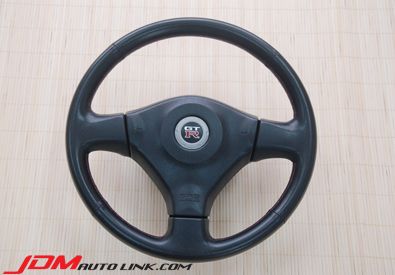

It was a pretty straight forward affair in removing the stock steering wheel. I knew that the airbags in the two steering wheels were of the same model, but there was no harm in checking. To do this, the side latches were opened up and the airbag housing unscrewed. Fortunately, the sockets all matched up, so we were good to go. Do note that this modification is only possible in Series II / late model R33 GT-R's, that feature driver and passenger side airbags. If you have an older BCNR33, then you're unfortunately out of luck. This is confirmed for Series I R33 GT-Rs. Oh and did you know that airbags have a shelf life? The one in my stock R33 GT-R steering wheel has clearly gone pass it's expiry date (circa 1997!), while I'm hoping the R34 GT-R's airbag is still good for a couple more years. Food for thought, gentle people.


Now all that was left to do was to line up the R34 GT-R steering wheel and bolt it in. I have to say that due to the tri-star design, the steering wheel feels much smaller and more chuckable. I just love it because it's a straight fit (no adaptation needed), looks like it belongs there in the first place, is much smaller than the unit that it replaces and really spruces up my R33's interior. Aki, you should really do this mod, mate ;).

Wednesday, October 5, 2011

The birth of a 520-hp Nissan Juke-R


Nissan's (and Renault's) Brazilian CEO, Carlos Ghosn, is always to looking to push the boundaries of automotive engineering. It would seem that he shares this trait with his engineers. 

What can be more innovative and exciting than trying to meld a Nissan Juke and a Nissan GT-R together? This what the Juke-R is all about: the ultimate compact crossover that's packing a 520-hp engine. Shoehorning a VR38DETT and the CBA35's drivetrain into this mini SUV is no mean feat!


Head on over to the Nissan JUKE Official Facebook page to find out more on this amazing project: http://www.facebook.com/NissanJukeOfficial

Monday, October 3, 2011

R33 GT-R Update: Nismo Performance Damper Set

I first read about this particular Nismo product on a fellow BCNR33 owner's blog. Thanks Aki and our cars are awesome!

My brand spanking new Nismo Performance Damper Set has finally arrived from Japan!
After looking into the matter further, I've discovered the following: the technology was originally developed by Yamaha and through collaboration with Japanese carmakers like Nissan, Subaru and Toyota, the technology was slowly disseminated among their respective models. The rally tuning arm of Subaru for example, Subaru Tecnica International - or better known as STi, produce these dampers for their cars - like the WRX STI Spec C Type RA-R.

Try to decipher this STi diagram that explains the benefits of the performance damper - if you dare!

Anyway, here's the official marketing spiel from Nismo:

Even if the car body is reinforced and made more rigid, road surface input through the tires and load shifts during cornering make the entire body act like a spring, causing the occurrence of micro vibrations. The performance damper acts to control the transmission of micro vibrations to the body. During circuit driving, micro vibrations from the car body are transmitted through the steering system to the driver, resulting too often in unnecessary steering corrections. With the performance damper installed, however these micro vibrations are eliminated and excessive steering wheel handling is no longer needed, resulting in more stable handling. Also, in normal driving, the micro vibrations are eliminated, as well providing a much more enjoyable and comfortable ride.


So how does it all actually work? Well heres how. The following pictures will illustrate that a car's front strut towers is not too disimilar from a tuning fork. Now when you strike the fork, you tend to get a nice ring out of it. So imagine if you will, pieces of tubular steel welded up like a giant tuning fork. When you hit it with a hammer, the fork will emit a really loud ring, right? The next step in the demonstration is where the top of the fork is boxed off, like as if it were a strut tower brace that was installed between your car's strut towers. The next time you hit it with a hammer, it should resonate with a low dull tone i.e. a dong like sound. The final step is to have a damper installed between the forks. At the moment a hammer hits the metal piece, it should not emit any noise at all. People have described it like hitting a pillow with a hammer. Isn't that just amazing? The Japanese have done it again! Innovate!

DING!
DONG!
*SILENCE*
For the short period of time that these have been on my GT-R, I've definitely felt a difference. The Skyline is more compliant over bumps and various imperfections that are on Malaysian roads. In a straight line, noise and vibrations are slightly reduced, but its when taking turns that you really feel the full benefit of these dampers. There's very little disruption nor unwated steering wheel movement when taking sharp bends and corners.

The rear damper installed! It bolts on directly behind the stock GT-R rear strut brace! :)
I'm not a professional driver, but I do feel that the GT-R is now more connected to the road with the performance dampers installed. Feedback from the car is greatly improved and you know whats going on beneath those tyres. I actually thought it would be the opposite, that the dampers would absorb shock thoughout the chassis and it would result in a numb steering feel - but that is definitely not the case here!

The front damper installed! A bit more effort is required, clearly!
A great product from Nismo and Yamaha. These should be installed on all GT-Rs.

I'll end my post with a Yamaha press brief, which goes into detail on their technology and how it was first developed:

It is widely known that chassis performance is an important factor that functions along with suspension performance to determine the handling stability and the comfort of the ride in an automobile. For this reason, the various auto makers have invested great efforts in optimizing chassis rigidity as an important component of chassis performance. Amidst these efforts, a new project was undertaken at Yamaha Motor Co., Ltd. to develop a "performance damper" the aim of which was to greatly improve chassis performance in a way that went beyond mere optimization of chassis rigidity by adding appropriate amounts of cushioning effect at certain points.

After the basic concept of the performance damper was proven valid in actual road tests in the autumn of 2000, development efforts to put it in applicable form and improve its performance were carried out at a rapid pace. It then made its appearance as a world's-first technology on the Toyota Crown Athlete VX (2001 limited edition of 300 units). Finally, in April of this year it appeared for the first time in the world on a full-scale production model, the sports grade version of the Toyota Corolla to be shipped to the domestic Japanese, European and North American markets.
The performance damper has a simple structure and is easily mounted on a chassis, and not only does it improve handling stability and ride comfort, it also reduces vibration noise. What's more, these effects are so marked that any driver can feel the difference in normal driving, not just in extreme driving at the hands of trained test drivers. Many domestic and foreign car makers have evaluated the performance damper very highly and expectations are high that it will become a common structural element of cars from now on.

Friday, September 16, 2011

S13 Update: Engine Rebuild


With the R33 GT-R nearing where I want it to be in terms of performance and appearance, I've decided to focus my attention on the S13 Coupe.

As such, the car is currently underdoing an engine rebuild. It will be sporting a new turbo, forged pistons, intercooler and a whole lot of other performance parts. I am targeting for the rebuilt engine to make 380whp to 400whp. I'm looking for useable power and not large hp numbers, seeing as this car is meant for the track. I might upgrade to a Garrett GT30 in the future (for top-end power) but I first need to familiarise myself with the car and its handling characteristics.

To this end, the following parts have been requisitioned:
  • Garrett GT2871R Ball Bearing Turbo
  • Tomei Cam 270 Procam
  • Tomei Valve Spring
  • Tomei Cam Gear
  • Tomei Rocker Arm Stopper
  • Trust Type R Intercooler (GT-R spec)
  • Titan Retainer
  • Supertech 86.5 Forged Piston Set
  • Cometic Metal Head Gasket
  • OEM Rebuild Gasket Kit for SR20DET
  • Turbosmart Ultra-Gate38
  • Jun Intake Manifold
  • Custom Banana Exhaust Manifold
  • Custom Exhaust System
Some of the parts have arrived while others will be brought in according to when they are needed (like the turbo for example). From time to time, I will be posting up reviews on some of the rebuild parts.

At this moment in time, my S13 has had it's engine bay resprayed and the car is currently being fully rewired. The reason for this is that the rebuilt engine will be controlled by a Haltech Platinum Sport 1000 Engine Management System (EMS). The rewiring is also for peace of mind.


Stay tuned for future S13 Updates!

The Tomei parts have already arrived
The SR20 taken out and the engine bay being prepped for painting
My S13's engine bay has been repainted white! :)

Monday, September 12, 2011

Worth Watching: Nissan HR31 GTS-R

"A lot of people don't understand. I don't have expensive hobbies... I don't go out and buy expensive shoes or clothes or anything like that. My hobby is my Skyline" - Ash Cosgriff

Couldn't have put it better myself. Good on ya mate.


Ash and Mick talk Skylines - HR31 GTS-R from Daniel De Silva on Vimeo.

Saturday, September 10, 2011

Triple Threat: Awesome Threesome Part 1

Good news folks. 

Awesomepowered.com have finally released their pictures of the photoshoot that my S13 Coupe was involved in. This is the first part of the S13 special - the second part will contain the video footage that we caught last weekend. 

So click on the link below and checkout the awesome pics!

http://awesomepowered.com/2011/09/silvia-feature-awesome-threesome-part-1/

In the meantime, here are some of the pictures they took of my coupe:


Triple Threat: S13 Coupe Video & Photoshoot

Last week, I decided to do something different to the usual Sunday drive up Ulu Yam.

Very last minute but it has been on the cards for awhile now - to organise a proper video and photoshoot of S13 Coupes, in and around Bukit Tinggi and Ulu Yam. The reason behind this endeavour was to help promote and provide maerial for two motoring websites which are owned by some friends of mine. They are http://awesomepowered.com and http://www.drift.com.my/v2.

The plan was simple, get three S13 Coupes owned by myself and two other friends to come along, accompanied by support / chaser cars. The convoy assembled early Sunday morning and the Coupes were joined by a Nissan Grand Livina and a Perodua Myvi. They made for ideal support cars seeing as both had wide rear opening doors, so as to allow photographers to film and take shots of the convoy.


Our first stop was Bukit Tinggi and the convoy made its way there via Karak Highway. This afforded us the opportunity to take some highway / wangan shots. For those not familiar with Bukit Tinggi, its a small town in the Bentong district of Pahang, Malaysia.


Upon reaching the foot of Bukit Tinggi, we had to stop and get the filming gear ready. Our arsenal consisted of a couple of DSLRs and ContourHD portable cameras.


We then proceeded up the hill, along it's many winding and twisty roads. This was my first time at Bukit Tinggi and now I realise why its such a popular destination for motoring enthusiasts. This is also where the Berjaya Hill Climb is held annually.

Since I was too busy driving at the time, I'll let the professionals wow you with their work, which will be released soon. They really did a good job in capturing our cars in motion. No mean feat as the red S13 was nearly always in sideways motion!


After burning rubber and leaving skidmarks all over Bukit Tinggi, we made our way back onto Karak Highway and headed up Genting Highlands. While on the highway, we took the opportunity to once again capture wangan style and line abreast shots of the S13s. We even managed to capture fly-by and tunnel run videos! Heres a sneak preview of the what to expect:


Upon reaching Gohtong Jaya, which is the midway point to the top of Genting Highlands, the team took a break and grabbed some much needed sustenance. One of the photographers had brought his Macbook along and this allowed us to view the footage that was captured earlier. Needless to say, we were quite pleased with the end result. With a bulk of the work already done, the last part of the shoot was to take place at the Gohtong Jaya helicopter pad. It looks down onto the valleys below and would make for a very touge-like setting - definitely a good place to end the day. It was blistering hot by then, as it was nearing 2 pm in the afternoon. This is how myself and most of the others got sunburned - something we only realised much later, well after the photoshoot.

I'll leave you with these shots but stayed tuned for future updates as the official photos are currently being processed by our team of photographers. I'm especially looking forward to the videos that were captured! Truly an awesome powered day.


Tuesday, August 23, 2011

S13 Update: Late Model S13 Front Bumper & Side Skirt

I'll say it again - stock is best. 

I wasn't too pleased with the bodykit that came with the S13. The Origin Widebody 20mm kit is great but the URAS body parts on the car are just a tad bit too loud, and the overhangs are excessive. For example, its really difficult to jack the car up bacause of the flaring URAS sideskirts. Now, if you were going to be actively driving at Sepang's International Circuit, your going to have a hard time changing tyres or making small corrections to the car's suspension. I don't know how drifters do it but the URAS bodykit had to go!


Another thing that needed to be removed was the rear bootlip spoiler, which doesn't really compliment the car. It also doesn't have that much aerodynamic properties. I've always been a fan of the S13 hellaflush look anyway.


Although I have to admit, I did have some moments where I thought to myself "Hmmm, it doesn't look actually that bad..."


I even had some Fatlace / Stance:Nation moments, which was 50/50 at best, in terms of how I felt about the car's looks.


But unfortunately, the URAS kit still had to go and I proceeded to google up some alternatives. Now since I've always been a fan of the stock look, I decided to search for a late model S13 front halfcut. Thanks to Ben Jamin, a good friend of mine, I managed to find one:


A front halfcut like this is quite rare in Malaysia and normally we don't get a lot of S13 bodyparts. There seems to be a general preference for the 180SX and thus, hatchbacks greatly outnumber S13 Coupes. Thats good for me because that makes my car that much rarer and unique.

With the front bumper procured, the next step was to find matching sideskirts. Thanks to Joe-Han from Drifthouse, I managed to get a pair of Trust Gracer (GReddy) S13 sideskirts :). I decided to leave the URAS rear bumper skirting as it matches well with the new bodyparts.


With the necessary ingredients in hand, the S13 was sent to the paint shop and this was the end result! Thanks to Chris from Exquisite Auto Haus for the great job on colour coding the bodyparts and putting them on the car :).


Shes looking mighty fine now, eh? If that was not enough, I removed the bootlip spoiler too and now its sporting the hellaflush look! You can't beat a S13 when it comes to carrying off the clean look! Just superb and I'm very happy with how things turned out!


R33 GT-R Update: Carbing Air Diversion Plate


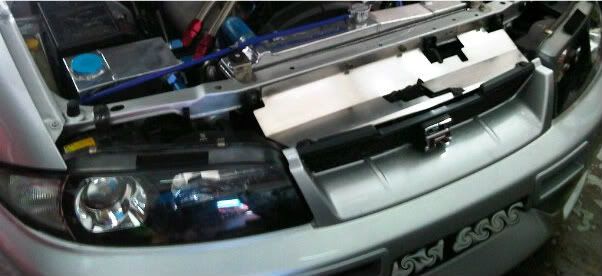
A radiator cooling plate is a device that helps direct air to flow from a car's grille straight to it's radiator. This promotes better cooling as more air flows through the radiator fins. The plate is installed between the front grille and the top section of the radiator. They are normally made out of aluminium but you do get some carbon fibres ones as well.

What normally happens is that, air escapes from the top of radiator instead of going through the radiator. Cooling plates help restrict the escaping air and divert it to where it really needs to go.

The results? It actually works! I've noticed that when the engine is fully warmed up, the water temperature reading is lower by 10% - 20% and this was after the Carbing Air Diversion Plate had been installed. Its amazing how something so small can have a positive effect on a car. Plus it makes the engine bay look that much nicer!

Why Carbing you might ask? Well...


Since the establishment of OKUYAMA Co.,Ltd. as an After-Market Auto Parts Manufacturer in 1977, Carbing has been developing various parts including Roll Bars, Strut Bars and Body Reinforcement Parts.

The company has their own motor sports team, “TEAM OKUYAMA”, that has been aggressively participating in Japanese domestic motor sport competitions like JAPAN NATIONAL DIRT TRIAL CHAMPIONSHIP as well as JAPAN GYMKHANA CHAMPIONSHIP. Team Okuyama became Champions in Class D (unlimited modifications) at the JAPAN GYMKHANA CHAMPIONSHIP for 3 consecutive years (1988-1990).


They also became the Series Champion in 1993 with their Mitsubishi Lancer Evolution I at JAPAN NATIONAL DIRT TRIAL CHAMPIONSHIP. And in 2003 they were Champions again with their Mitsubishi Lancer Evolution III.


All of Carbing's modification parts have been developed/manufactured using the practical data that had been acquired in the above-mentioned competitions.

Sunday, August 21, 2011

R33 GT-R Update: Defi-Link Display, Defi-Link Control Unit II & Defi-Link BF Boost Meter

Stock is best in my book. Thats the reason why I've been very conservative thus far with GT-R's outward appearance.

The same principle applies to the interior, as I'm not one to go bonkers on flashy gauges and large display LCDs. Nonetheless, I need to know whats going in the engine bay, in light of the car's new power output. Things like having an accurate reading of the RB26's oil temperature, water temperature, oil pressure and so forth, are crucial to ensure the longevity of the newly rebuilt 2.6L engine. But how do we avoid the problem of having too many gauges cluttering up the dashboard? Not only do they attract the unwanted attention of thieves, by having too many sensors drilled into your engines bits, it will create unnecessary stress points all over the block.

Enter the Defi-Link Display.


Defi-Link Display is a multipurpose monitor which provides information on speed, oil temperature, water temperature, oil pressure, fuel pressure, and exhaust temperature by connecting to the Defi-Link Control Unit II or the Defi-Link Control Unit.

Real-time digital information includes speed, oil temperature, water temperature, oil pressure, fuel pressure and exhaust temperature. Sensor sets need to be purchased separately to display the information on pressures and temperatures.

Vehicle performance data and peak values are placed in memory for 3 minutes, allowing examination of data after running the vehicle.
*Defi-Link Control Unit II has a 3 minute memory. Defi-Link Control Unit has a 40 second memory.

The Warning LED lights when the set warning value is exceeded for oil temperature, water temperature, exhaust temperature and engine RPM. The Warning LED lights when measured value drops below the set warning value for oil pressure and fuel pressure.

Defi stopped producing this particular display in 2010, so I was fortunate that my tuner sourced a unit along with some goodies; a Defi-Link Control Unit II and a Defi-Link BF Boost Meter. All three were in good condition and we got them for a steal. Even though Defi now offers a more advanced display, which is the Defi-Link Meter ADVANCE ZD, I don't really fancy the new look (garish gold backlight), it's is too big (awkward to mount) and I'm fine with having only two readings on display at any one time. The rev counter is a nice feature but not necessary and there's standalone products like Shift-I's Progressive Shift Indicator, which does the exact same thing.


Defi-Link Control Unit II is a necessary controller to install Defi-Link Meters, Defi-Link Meter BFs, and Defi-Link Displays. Up to 7 gauges and displays can be connected and controlled by one Control Unit II. Defi-Link System allows gauges and displays to be attached to Defi-Link Control Unit II with a single daisy chain wiring system. Driving data can be stored and can be replayed up to 3 minutes. Pause, speed play, forward, and rewind function can be applied during playback.

As for the Defi-Link BF Boost Meter, press the play button in the flash animation below and you'll be able to see how the unit activates once the ignition key is switched on:


And here is the end result :). Quite pleased with how things turned out as I hate the look of gauges scattered all over the interior. However, as I had mentioned earlier, it is necessary to know the parameters of your engine and the Defi device helps with this. So to reiterate, I've found the Defi-Link Display to be convenient since it's small and more importantly, allows me to monitor the GT-R's 'health' through a series of readings. They are essentially; water temp, oil temp, fuel pressure, oil pressure and exhaust gas temperature. Imagine if you had to get gauges for all of those things .That would be one heck of a lot of gauges. Also, peak / warning settings are a breeze to configure, and with the built-in warning feature, trouble parameters can also be set easily. 

Oh and lastly, it looks pretty darn good too, especially at night.


Friday, July 8, 2011

Project Time Attack: Nissan S13 Coupe


In my previous blog post, I spoke of finding the right car to be turned into a time attack machine. After much deliberation and looking at several makes and models, I've narrowed the field down to one car and thats a 1990 Nissan S13 Silvia Coupe. 

My decision to go with a S-Chassis is primarily down to six factors, some of which were mentioned in the previous posting but will be further extrapolated here: 

  • Good, affordable rear-wheel drive base to build up from
Front-engine, rear-wheel drive (FR) cars have a natural tendency to oversteer. Controlled oversteers can technically help you set faster track times but can be very difficult to control.This naturally happens as the rear wheels are used for acceleration, while the front wheels steer the car. Rear wheel drive (RWD) cars tend to balance towards 'oversteer' which sees the front of the car pulling to the inside of the corner (whilst the rear comes out). As some of you might well know from seeing drifters work their magic, some opposite lock, combined with acceleration, can help nip this problem in the butt. Therefore, if given sufficient grip, RWD is near perfect for track  - proof of this being that every major motorsport event in the world uses the FR layout. Even current most popular all-wheel drive (AWD) car in the world today, the Nissan R35 GT-R, has dropped its AWD system in favour of a FR setup, as Nissan seeks to dominate proceedings in the Super GT series. 

  • Easy to get power out of the Nissan SR20DET engine
The SR20DET is a highly tuneable engine and its popularity is based on the motor's ability to produce power on the cheap. Also, the SR20's all alloy block, alloy heads, twincams, 16 valves and an intercooled T28 turbo, indicates that the engine possessed technology that was ahead of its time. This makes it a good engine to use in amateur motorsports.

  • Option to retro-fit parts from other Nissan models
Something I've learned and come to appreciate after months of GT-R ownership is that, Nissan parts are highly interchangeable. Not only does this feature exist between cars that belong to the same family tree but also with other Nissan cars that were made on a different production line. This is also inter-generational feature - S13 can for example, make use of newer parts that were a standard feature on later model Silvias like the S14 and S15. 

  • Massive amount of aftermarket parts
Testament to the popularity and longevity of the SR20DET, the engine enjoys tremendous aftermarket support and is fully backed by all major Japanese tuning houses. Even till present day, its easy to procure new aftermarket parts for an S13, as these items are still in production.

  • Huge supply of halfcuts and spare parts that are already in Malaysia
This has to do with the fact that the SR20 was used to power many of Nissan's cars since the early 1990s. Hence, a large supply of halfcuts and parts have made their way onto Malaysian shores. Production numbers of the S13 alone, is staggering - some 251,410 units were built from 1989 to 1998.

  • Proven track platform
Furthermore, the track capabilities of the S13 Coupe have been amply showcased at Sepang by Yoong (Ee Yoong Chern) and his HKS Garage R Hiper S13. The car lapped a best time of 2.26:5 at last year's Time to Attack Sepang and was ranked 4th overall. I got to know of Yoong through the Malaysian Skyline fraternity as he owns a R33 GT-R as well. You should see him drive it up Ulu Yam.


These following pics were taken prior to delivery of the car. I purchased the vehicle for a song and it came equipped with some goodies (widebody kit / S15 five lug conversion / R32 GT-R brakes / half cage though). The body is also very straight.

The S13 is currently undergoing a major make over - all of its consumables have been a changed, a JIC adjustable suspension installed, a new S14 gearbox bolted in, a Nismo GT LSD for the rear and lastly, 17" Work +5 offset rims with new tyres to help it steer better. I'm hoping it'll be ready for this weekend, so I could join a jaunt up Gohtong Jaya with the Italia Auto boys.

Ignore the drift, ricey bits. Those will be rectified in due time and a 2.2 stroker kit + Haltech ECU + cams + disco potato will be going into that SR20DET: